

As a box turtle keeper, you may ask yourself the question: Is my box turtle male or female? But how do you tell the sex of a turtle? Since box turtles have their sex organs inside their shells, it is difficult to determine its sex. To identify the sex of a box turtle, other secondary sex characteristics must be used. I’ve listed many of these secondary chracteristics here for you to use to help determine the sex of your turtle.
The most common box turtles found in the pet trade or along road sides and fields are the Common box turtle, the Eastern box turtle, the Three-toed box turtle, the Gulf Coast box turtle and the Western Ornate box turtle. They each have a distinctive look but some individuals are hard to identify, and everyone wants to know what sex their turtle is. This post describes the differences in physical traits of the sexes.
Click here for a full overview of all types of box turtles.
However, sometimes the external, physical characteristics don’t prove anything with certainty and the only thing to do is observe the turtle for a time and wait for obvious signs to occur, like penis-fanning in males and egg laying for females.
Three-Toed box turtle, common box turtle and Eastern box turtle sex determination
The body color of male and female Eastern box turtles could indicate their sex
The first thing to look at is the overall body coloration. Males of Eastern box turtles usually have more colorful heads and legs. They have more red, or orange and white and black on their face and neck. Compare these two pictures of a male and female Three-toed box turtle. The eyes of mature males are usually red or reddish, whereas the eyes of a female box turtle are usually deep brown.


The differences in the plastron of a female and male box turtle
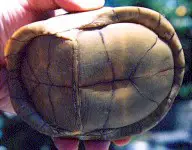
The plastron of many males has a slight concave area, or a depression that allows them to mount the females more easily. However, this is not a 100% sure way to tell if a box turtle is male of female. Many males do not have this depression. But if your box turtle does have the depression, you can be fairly certain that you have a male box turtle. Here is a picture of the plastron of a male three-toed box turtle (T. c. triungus).
Sexing a box turtle from their back claws
The back claws of male and female Eastern box turtles are different. A male’s back toe are thicker and curve markedly, like small talons. The female back toes are thinner and straighter. You can see the differences in these pictures of the back foot of the Common Eastern box turtle (T. c. carolina).
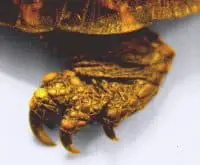
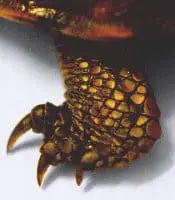
The difference of the tail of a male and female box turtle
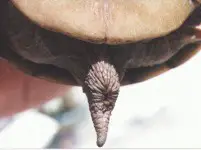
The tails of male Eastern and Western box turtles are thick at the base where it joins the body. The tail is long and the anus is further down the length of the tail than the females’. Here is a picture of the tail of a male Three-toed box turtle (T. c. triungus). Notice the anus is beyond the edge of the shell. A female’s tail is shorter and the anus is usually placed close to the body, within the edge of the shell.
How to determine the sex of Western box turtles (Terrapene ornate)
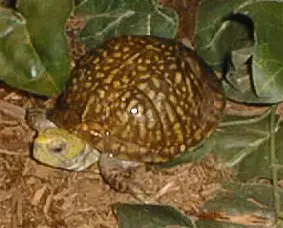
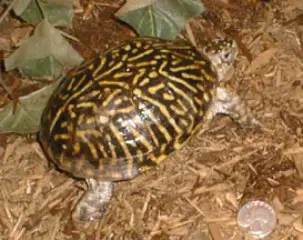
Telling the sex of the Western Ornate box turtle by the body color
As in the case with male Eastern box turtles, the male Western Ornate box turtle usually has a different body coloration than the female. The heads of mature males are usually some shade of green and their legs have bright orange or red scales. The females have brown heads and their legs have yellow scales. The eyes of male are red and the females are brown.
We hope this overview has taught you a lot about how to tell female turtles from males. Overall, it can be said that the colors, the plastron and the back claws are the best indicators for sexing a box turtle.
Make sure to also check out our helpful posts on what to feed a box turtle and how to set up the perfect habitat for your pet turtle.
If you still have any questions, let us know in the comment section below.
The pictures posted on this post are either from Roger Louie or Jeff Dawson. I thank both for permission to use their photographs. If you have any pictures of your box turtle to share, we would be happy to display them on the page here. Just send us an email to boxturtlesite@gmail.com
Disclosure: The section below contains affiliate links. At no extra cost for you, we may receive a commission if you purchase products mentioned below.
Pin this post for later by clicking on the image below:

3 thoughts on “Is my box turtle male or female? Tips on how to tell the sex of a turtle”
Comments are closed.