
The diet of a box turtle is one of the most crucial factors in maintaining a healthy animal. Getting a turtle to eat or to eat the proper nutritious foods is often the hardest thing a turtle owner must learn to do. If you are asking yourself the question “what do box turtles eat?”, you are in the right spot. This post has all the information about the box turtle diet. However, not only the diet itself is important to keep your box turtle healthy but also the environment in which it is kept and fed.
Since this is a rather long post, you can find the main contents here. Just click on the titles and you will get right to the correct content section.
- How often should you feed your box turtle?
- The ideal balanced box turtle diet
- What if your box turtle won’t eat?
- The importance of minerals and vitamins in the box turtle diet
- Full list of food items and nutritional values for box turtles
- Box turtle food FAQs
Disclosure: This is post contains affiliate links. At no extra cost for you, we may receive a commission if you purchase products mentioned below.
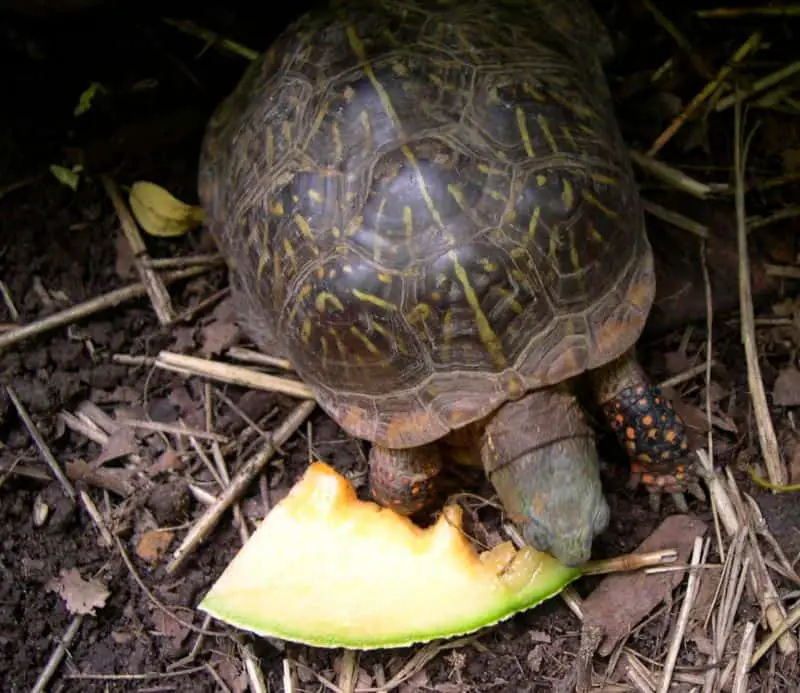
What do box turtles eat?
Wild turtles are omnivores and in will eat earthworms, snails, grubs, beetles, caterpillars, carrion, grasses, fallen fruit, berries, mushrooms and flowers. They will take a bite of anything that smells edible in their natural habitat. Ornate box turtles that live in the grasslands of the Great Plains also feed on wheat grasses. This is the diet that is best to follow. Give in moderation all types of edible food. But is the food something the turtle wants to eat? If you see that your box turtle refuses certain types of food, it may just be because it doesn’t like it.
Do not feed your box turtle junk food
But they won’t come across cheeseburgers or bacon and eggs in the wild! You must feed your turtle what it needs to eat, not what is convenient for you to give it. If you find something your turtle really loves, then you are half way to retraining any bad eating habits.
If it loves earthworms then try giving it chopped worms with grated yellow squash and cantaloupe. Or a plate of worms and chopped collard greens and strawberries. A list of good food items is presented later in this section.
How often should I feed my box turtle?
Feed young turtles a small amount of food every other day. Adults can be fed every 2 or 3 days in late spring and summer. Find more information on the diet of hatchling box turtles in our post about breeding box turtles here. Regardless of the age of your box turtle, a feeding schedule should be made in advance.
During the summer months when I’m trying to strengthen and add weight to my box turtles, my schedule may be like this: Monday, Wednesday and Saturday are full meal days. Other days I may feed a small snack where they might get a beloved treat like bananas or tomatoes sprinkled with vitamins. On Sundays the turtles receive no food. A day of fasting will not harm a healthy turtle.
Of course, use your own best judgment. You may want to feed more or less often depending on the health or activity level of your turtle. However, clean water should be provided daily.
Must-have food items
Overall, box turtles need a lot of calcium in their diet. This helps them grow a healthy shell. While several factors influence the absorption of calcium, it is very important that your turtle gets a lot of calcium in its diet. Later, we will show you the ideal diet that will ensure a healthy and happy turtle.
However, irrespective if you keep your pet boxie indoors or outdoors, you should always provide it with some natural cuttlebone. You can just put some into the enclosure and the turtle will bite on it as it sees fit. This will ensure a good trim to the beak as well as a healthy calcium intake. You can buy natural cuttlebone here on Amazon (or by clicking on the image below) or in pet stores.


You should also add additional calcium powder to the food you serve your turtle 2-3 times per week.
The ideal box turtle diet
Box turtles have specific dietary needs to ensure good health. A well-balanced diet is easily provided from a combination of common grocery store items and backyard biota. Following is a list of foods to give your box turtle. Most foods are acceptable if given in moderation. Each feeding should include a food item from several food groups. For example, include a protein, a vegetable and a fruit. Or a protein, a fruit and a green leafy vegetable. By varying the diet of your box turtle, you are increasing the chances that they will get the mineral and vitamins necessary for good health. You also lessen the chances of them fixating on just a few foods. Plus it is naturally for box turtles to have a varied diet.
The ideal diet of a box turtle consists of 50% proteins, 30% vegetables, 10% green leafy vegetables and 10% fruits. Below you can find some more details and do’s and don’ts when feeding your box turtle.
Proteins
PROTEIN makes up about 50% of the box turtle diet. Protein foods should be cut up small enough so the turtle cannot get its fill of food with just one bite of protein. Mix the protein with the vegetables and fruits.
All muscle meats should be sprinkled with calcium supplement that contains no phosphorus. Cuttlebone given to birds may also be shaved onto food stuff and left in the turtle’s home so the turtle can forage on it at will. It is high in calcium and other trace minerals and should always be available to box turtles.
- Use regularly – Natural live, whole foods like pesticide free earthworms, slugs, waxworms, beetles, grubs, sow bugs. Boiled, chopped chicken, feeder fish or beef heart.
- Occasionally – Low-fat soaked dog kibble, soaked puppy Milkbones®, low-fat premium canned dog food, cooked lean steak, mealworms and crickets that have been gutloaded on dark greens, prepared box turtle food products.
- Less frequently – Pinky mice, boiled egg, tofu, low-fat cat kibble.
- Never – Due to the possibility of contamination, fat content and salt: raw meats, fatty meats or processed meats.
Vegetables
VEGETABLES make up about 30% of the diet. Use the part of the vegetable that is colorful as it contains the most nutrition. Use fresh vegetables whenever possible and steam or grate hard vegetables before offering to the box turtle.
- Use regularly – Summer and winter squashes, peas in the pod, sweet potatoes, okra, grated carrots, green beans, wax beans and cactus pads with all spines removed.
- Occasionally – Mushrooms of all types, corn on the cob and tomatoes.
- Less frequently – Bean sprouts, broccoli, cabbage, beets and cauliflower.
- Never – Avocado peel.
Leafy Dark Greens
LEAFY DARK GREENS make up 10% of the diet. Dark leafy greens contain fiber and many minerals and vitamins. Greens help keep the turtle gut healthy through their cleansing action. Always provide your turtles with greens.
- Use regularly – Collard greens, mustard greens, dandelion greens, romaine, wheat grass and turnip greens.
- Occasionally – Red leaf lettuce, endive, parsley, kale and Swiss chard.
- Less frequently – Iceberg lettuce and spinach.
- Never – Rhubarb, potato and tobacco leaves.
Fruits
FRUITS make up the remaining 10% of the diet and are dessert for your turtles. Most turtles love fruits and each seems to have a favorite. Try to find your turtle’s favorite. If it is a finicky eater, use the fruit to entice it to eat other foods. Chop the favorite fruit into small pieces and mix it with things the turtle should eat but won’t. This way, with every bite of fruit it will also eat the required food. I sprinkle vitamins on the fruit as well.
- REGULARLY – Grapes, apples, fresh figs, blackberries, raspberries, mulberries, peaches, crabapples, strawberries, cantaloupe, kiwis, cherries and persimmons, banana and most other fruits.
I don’t mean to imply the above diet is the only way to feed your pet turtles but I follow the diet and have produced healthy box turtles with smooth shell growth and strong immune systems. The effort a person puts into the diet is directly proportional to the health of the turtle. Read about the natural history of wild box turtles and learn what they eat and try to follow a natural diet.
What if your box turtle won’t eat?
For some reason, many turtles, especially wild caught turtles, will not readily eat. They may even be fixated on certain foods. It may have something to do with the stress of captivity, changes in the environment, or removal from their home ranges. Temperature and lighting play a role in triggering appetite and turtles no doubt have their own food preferences. A turtle not given the proper circumstances to feed will go on a hunger strike. Unlike warm-blooded animals, they aren’t forced by their metabolism to eat. They can just slow down their activity level, retreat in their shells and wait for better conditions.
Unfortunately, if the turtles are kept in a tank or penned in an outdoor area, those better conditions never come unless the owner makes an effort to supply them. If they aren’t supplied, the turtle will slowly grow weaker and becomes debilitated, sick and eventually dies. It’s important to find out what is required to get your turtle to eat.
Is it warm enough for your turtle to eat?
These are some of the first causes to look for when box turtles refuse to eat.
If the box turtle is outside, try feeding it during late morning hours or after a light sprinkling of water. If it is early in the year or late in the fall, you may need to adjust the time of feeding to a later hour so the turtle has a chance to warm up first.
When nighttime temperatures go below 65° F (18° C), the turtle will need to warm up its body temperature before it will feed. Cold turtles cannot digest their food properly. Therefore location is important when considering a place for an outdoor set up. Check to see where you have placed the enclosure. If the enclosure faces the east, it will get morning sun. But if it is on the west side, it may not get sun until later in the day. West- and north-facing enclosures are not ideal.
Some box turtles won’t eat in the open because they are very timid. You need to provide an eating area where it feels safe, for example, near a shrub or under a hide box. Is the food in the sun or shade? Try putting the food plate in an area where it is partly shaded in the summer. A turtle can overheat very quickly, and it may not venture out into the sun to eat if it is too hot.
The right temperature and light is important
If your turtle is kept indoors, and this is recommended only for hatchlings and sick or weak box turtles, then you have other factors to consider if your turtle won’t eat.
Is the ambient temperature too low or too high? There should be a gradient of temperatures in the housing with the warm end being around 85-87° F (30° C) and a cool area around 75-78° F (25° C). This cool area could be where the hide box or burrowing area is placed. Feed the turtle at the same hour and place each time.
A UVA and UVB producing fluorescent lights can make foods more appealing to turtles by bring out the colors. It may also stimulate appetite in much the same way a nice bright sunny day makes us happy. Full-spectrum light is also necessary for vitamin D3 production, especially if your turtles is not getting vitamin D3 from food and is not living outside.
Read more about the ideal indoor habitat for box turtles here and the required temperature and humidity levels for your box turtle here.
Make sure each box turtle gets enough food
Are several turtles housed together in close proximity? A dominant turtle may not let a weaker turtle eat. Make sure each turtle has their own food dish or fed in seperate areas if necessay. Place the food on shallow plates or tiles.
After you have eliminated all physical causes of a hunger strike and the turtle still does not eat, then you will have to look at medical reasons. For a beginning turtle keeper it may be hard to tell from just behavior if a turtle isn’t eating due to an illness.
If the feces look firm and no whitish mass of worms is seen, you can try soaking the turtle in slightly warm water that contains a few drops of reptile vitamins for half an hour each day for one week. The water should only go half way up the back of the shell and not over the turtle’s head. If a turtle still hasn’t eaten after a week, then a trip to a reptile veterinarian may be necessary.
If the eyes are closed and puffy, the box turtle will not eat and should be taken to a veterinarian. There are several reasons why the eye condition may be present. Vitamin A deficiency causes the glands in the eye to dry out and infection may begin. Upper respiratory illnesses can also cause the eyes to become infected. These conditions are best handled by a vet who may want to treat it with antibiotics.
Find more information on box turtle health here.
Importance of minerals and vitamins in the box turtle diet
In the early 60’s and 70’s, many hundreds of thousands of baby Red-eared sliders were sold as children’s pets. It was during this time that the effects of improper diet for turtles became appallingly obvious. Soft shells, deformed shells and paralyzed legs were common in many of the sliders. As breeders, veterinarians and researchers began to look into the problem, the mineral calcium (Ca) became the first choice to cure the deficiency. Calcium blocks were produced and sold but the problem didn’t go away.
More research showed that the absorption of calcium was controlled by several biochemical factors. Not only was calcium necessary, but the proper amounts of phosphorus (P) and vitamin D3 were needed. Each of these vital elements and compounds will be discussed briefly, but the real purpose of this section is to teach you which foods contain the proper nutrition for box turtles.
Calcium
Calcium is a mineral that is obtained from foods or supplements. Calcium is absorbed by the blood system through the turtle’s intestine and stays dissolved in the blood until it is used by the body to build bones or for other organ functions. For calcium to be used by the body, a proper level of phosphorus and vitamin D3 is required. If a turtle does not get enough calcium, it will try to maintain a blood Ca:P blood level of 2:1 by stealing calcium from its own bones, causing metabolic bone disease.
Phosphorus
Phosphorus is a mineral found in abundance in foods that turtles eat. Therefore it is not usually necessary to supplement phosphorus. A calcium supplement without phosphrous and which contains Vit D3 is best to use.
Vitamin D3
Vitamin D3 is a vitamin that is produced by pigment cells in the skin and shell when a box turtle is in sunlight or other UVB producing light source. The vitamin is necessary for the conversion of calcium into useable compounds. Therefore buy calcium supplements that contain Vit D3.
Vitamin A
Vitamin A is a fat-soluble vitamin that is essential for good vision and health. It is found in foods that are orange fleshed like carrots, sweet potatoes, winter squashes, dark, leafy greens and cod liver oil. A deficiency of vitamin A can lead to eye infections and upper respiratory disease. Vitamin A rich food should be provided regularly.
The combination of various foods is important for box turtles
In the wild, a box turtle will have a large area in which to roam and forage for food and it would likely find all the nutrients its body needs. A deficiency would be unlikely. Many long-time turtle keepers will tell you that most wild turtles are very healthy.
As penned pets, our turtles don’t have the opportunity to forage on a lot of different things, and it’s up to the owner to provide the correct diet. For optimum health, a turtle should get the proper types and amounts of food items. The turtle should be given a “square meal” which contains protein, carbohydrates, fiber, calcium, and vitamins. An animal that doesn’t receive the correct diet can succumb to various diseases, metabolic bone disease, organ failure, and immune-suppression diseases.
It would be nice if we could insure that our box turtle is getting everything it needs from diet alone, but that’s not usually the case. No one has ever observed a wild box turtle from the moment of hatching and written down everything it eats. If someone does in the future, we’ll come a long way in understanding the nutritional needs of box turtles. We do know the Ca:P ratio of foods is important and therefore have provided a list of foods and their ratios.
Regularly use foods with a high Ca to P ratio and avoid foods with a high P to Ca ratio, and foods high in oxalic acid. The food items at the end of the list below should be use sparingly. If they are used, add calcium supplements without additional phosphrous to bring the calcium levels higher. However, this list should not be used exclusively to construct your turtle’s diet. Remember to include insects or other protein sources.
Full table of nutritional value of box turtle food items
The table below shows a listing of various food items and their Calcium and Phosphorus content. A listing of “2.00” in the Ca:P column represents a ratio of 2:1 and is good. The lower this number is, the worse the Ca:P ratio and the less it should be used in the diet. Most of this data come from the USDA. You can check the nutritional content of other food items at their website USDA.
| Food Item | Prep | Serving | Weight (g) | Ca (mg) | P (mg) | Ca:P |
| collards | raw | 1 cup | 36 | 52 | 3,6 | 14,4 |
| roselle | raw | 1 cup | 57 | 123 | 21 | 5,86 |
| lambsquarters | boiled | 1/2 c | 90 | 232 | 41 | 5,66 |
| papaya | raw | 1 med | 304 | 72 | 16 | 4,5 |
| turnip greens | raw | 1/2 c | 28 | 53 | 12 | 4,42 |
| coriander | raw | 1/4 c | 4 | 4 | 1 | 4 |
| rose apple | raw | 3.5 oz | 100 | 29 | 8 | 3,63 |
| parsley | raw | 1/2 c | 30 | 39 | 12 | 3,25 |
| amaranth | boiled | 1/2 c | 66 | 138 | 47 | 2,94 |
| dandelion green | raw | 1/2 c | 28 | 52 | 18 | 2,89 |
| cabbage, Chinese | raw | 1/2 c | 35 | 37 | 13 | 2,85 |
| beet greens | boiled | 1/2 c | 72 | 82 | 29 | 2,83 |
| lettuce, loose-leaf | raw | 1/2 c | 28 | 19 | 7 | 2,71 |
| kale | boiled | 1/2 c | 65 | 47 | 18 | 2,61 |
| figs | raw | 1 med | 50 | 18 | 7 | 2,57 |
| pricklypear | raw | 1 med | 103 | 58 | 25 | 2,32 |
| orange, Valencia | raw | 1 med | 121 | 48 | 21 | 2,29 |
| chicory greens | raw | 1/2 c | 90 | 90 | 42 | 2,14 |
| figs | dried | 10 figs | 187 | 269 | 128 | 2,1 |
| orange, navel | raw | 1 med | 140 | 56 | 27 | 2,07 |
| cabbage, green | raw | 1/2 c | 35 | 16 | 8 | 2 |
| carissa | raw | 1 med | 20 | 2 | 1 | 2 |
| kumquat | raw | 1 med | 19 | 8 | 4 | 2 |
| spinach (don’t use | raw | 1/2 c | 28 | 28 | 14 | 2 |
| watercress | raw | 1/2 c | 17 | 20 | 10 | 2 |
| onions, spring | raw | 1/2 c | 50 | 30 | 16 | 1,88 |
| endive | raw | 1/2 c | 25 | 13 | 7 | 1,86 |
| lime | raw | 1 med | 67 | 22 | 12 | 1,83 |
| raspberries | raw | 1 cup | 123 | 27 | 15 | 1,8 |
| sapodilla | raw | 1 med | 170 | 36 | 20 | 1,8 |
| mustard greens | boiled | 1/2 c | 70 | 52 | 29 | 1,79 |
| chard, Swiss | boiled | 1/2 c | 88 | 51 | 29 | 1,76 |
| leeks | raw | 1/4 c | 26 | 15 | 9 | 1,67 |
| lemon | raw | 1 med | 58 | 15 | 9 | 1,67 |
| grapefruit | raw | 1/2 med | 118 | 14 | 9 | 1,56 |
| blackberries | raw | 1/2 c | 72 | 23 | 15 | 1,53 |
| tangerine | raw | 1 med | 84 | 12 | 8 | 1,5 |
| grapes (slip skin) | raw | 1 cup | 92 | 13 | 9 | 1,44 |
| celery | raw | 1 stlk | 40 | 14 | 10 | 1,4 |
| sapote | raw | 1 med | 225 | 88 | 63 | 1,4 |
| tofu | uncook | ed1/2 c | 61 | 49 | 37 | 1,32 |
| green beans | boiled | 1/2 c | 62 | 29 | 24 | 1,21 |
| cabbage, red | raw | 1/2 c | 35 | 18 | 15 | 1,2 |
| turnip | boiled | 1/2 c | 78 | 18 | 15 | 1,2 |
| crabapple | raw | 1 cup | 110 | 20 | 17 | 1,18 |
| eggplant | raw | 1/2 c | 41 | 15 | 13 | 1,15 |
| garlic | raw | 3 clves | 9 | 16 | 14 | 1,14 |
| radish | raw | 10 rdsh | 45 | 9 | 8 | 1,13 |
| okra | boiled | 1/2 c | 80 | 50 | 45 | 1,11 |
| acerola | raw | 1 cup | 98 | 12 | 11 | 1,09 |
| tofu | raw | 1/2 c | 124 | 130 | 120 | 1,08 |
| pear | raw | 1 med | 166 | 19 | 18 | 1,06 |
| mulberries | raw | 1 cup | 140 | 55 | 53 | 1,04 |
| apple, w/skin | raw | 1 med | 138 | 10 | 10 | 1 |
| lettuce, iceberg | raw | 1 leaf | 20 | 4 | 4 | 1 |
| persimmon | raw | 1 med | 25 | 7 | 7 | 1 |
| pineapple | raw | 1 cup | 155 | 11 | 11 | 1 |
| elderberries | raw | 1 cup | 145 | 55 | 57 | 0,96 |
| mango | raw | 1 med | 207 | 21 | 22 | 0,95 |
| gooseberries | raw | 1 cup | 150 | 38 | 40 | 0,95 |
| currants, black | raw | 1/2 c | 56 | 31 | 33 | 0,94 |
| watermelon | raw | 1 cup | 160 | 13 | 14 | 0,93 |
| cranberry | raw | 1 cup | 95 | 7 | 8 | 0,88 |
| honeydew melon | raw | 1/4 c | 100 | 14 | 16 | 0,88 |
| grapes with skin | raw | 1 cup | 160 | 17 | 21 | 0,81 |
| cabbage, savoy | raw | 1/2 c | 35 | 12 | 15 | 0,8 |
| guava | raw | 1 med | 90 | 18 | 23 | 0,78 |
| cucumber | raw | 1/2 c | 52 | 7 | 9 | 0,78 |
| cherry | raw | 10 chrs | 68 | 10 | 13 | 0,77 |
| lettuce, romaine | raw | 1/2 c | 28 | 10 | 13 | 0,77 |
| casaba melon | raw | 1 cup | 170 | 9 | 12 | 0,75 |
| strawberries | raw | 1 cup | 159 | 21 | 28 | 0,75 |
| broccoli | raw | 1/2 c | 44 | 21 | 29 | 0,72 |
| apricot | raw | 3 me | 106 | 15 | 21 | 0,71 |
| dock | raw | 1/2 c | 67 | 29 | 42 | 0,69 |
| kiwifruit | raw | 1 med | 76 | 20 | 31 | 0,65 |
| Brussels sprouts | boiled | 1/2 c | 78 | 28 | 44 | 0,64 |
| French beans | boiled | 1 cup | 177 | 111 | 181 | 0,61 |
| cauliflower | raw | 1/2 c | 50 | 14 | 23 | 0,61 |
| blueberries | raw | 1 cup | 145 | 9 | 15 | 0,6 |
| carrots | raw | 1 med | 72 | 19 | 32 | 0,59 |
| cantaloupe | raw | 1 cup | 160 | 17 | 29 | 0,59 |
| fruit cocktail | canned | 1/2 c | 128 | 8 | 14 | 0,57 |
| squash, summer | raw | 1/2 c | 65 | 13 | 23 | 0,57 |
| apple, w/o skin | raw | 1 med | 128 | 5 | 9 | 0,56 |
| sweet potato | baked | 1 med | 114 | 32 | 62 | 0,52 |
| raisins, seedles | sraw | 2/3 c | 100 | 49 | 97 | 0,51 |
| zucchini | raw | 1/2 c | 65 | 10 | 21 | 0,48 |
| persimmon, Japan | eseraw | 1 med | 168 | 13 | 28 | 0,46 |
| tomato, green | raw | 1 med | 123 | 16 | 35 | 0,46 |
| peach | raw | 1 med | 87 | 5 | 11 | 0,45 |
| alfalfa sprouts | raw | 1 cup | 33 | 10 | 23 | 0,43 |
| asparagus | boiled | 1/2 c | 90 | 22 | 54 | 0,41 |
| beets | boiled | 1/2 c | 85 | 9 | 26 | 0,35 |
| banana | raw | 1 med | 114 | 7 | 22 | 0,32 |
| plum | raw | 1 med | 66 | 2 | 7 | 0,29 |
| avocado, Fla | raw | 1 med | 304 | 33 | 119 | 0,28 |
| tomato, red | raw | 1 med | 123 | 8 | 29 | 0,28 |
| nectarine | raw | 1 med | 136 | 6 | 22 | 0,27 |
| peppers, sweet | raw | 1/2 c | 50 | 3 | 11 | 0,27 |
| avocado, Cal. | raw | 1 med | 173 | 19 | 73 | 0,26 |
| peas, green | raw | 1/2 c | 78 | 19 | 84 | 0,23 |
| lima beans | boiled | 1 cup | 188 | 52 | 231 | 0,23 |
| kidney beans, red | boiled | 1 cup | 177 | 50 | 252 | 0,2 |
| potato (no skin) | raw | 1 med | 112 | 8 | 52 | 0,15 |
| mushrooms | raw | 1/2 c | 35 | 2 | 36 | 0,06 |
| corn, yellow | boiled | 1/2 c | 82 | 2 | 84 | 0,02 |
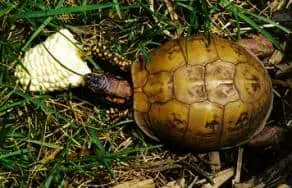
Notice this box turtle enjoying corn on the cob. Corn is very low in calcium and should not be giving regularly without calcium addition. But like all creatures, box turtles seem to really enjoy the foods that aren’t good for them!
I hope this post has answered the question what do box turtles eat. If you still have any questions, feel free to post them below. Next we collected the most frequent questions about what box turtles eat and their diet.
What is the best box turtle food – FAQs
Offer your box turtle food once a day. While box turtles do not necessarily require food every single they, they will leave the food if they are not hungry. If they refuse to eat for several days in a row, something may be wrong with their housing situation, they may have a medical issue or prepare for hibernation.
If you have baby box turtles, feed them around 3-4 times a week.
Box turtles drink fresh water. Make sure to provide your box turtle fresh water every day in a flat container.
Box turtles enjoy any type of insects and since they are very protein rich, you should also make sure to include insects into the diet of your pet turtle. You can either catch the insects yourself or give your turtle the chance to do so or buy them in pet stores or online. You can feed the following types of insects: mealworms, wax worms, super worms, earthworms, crickets, grasshoppers, beetles, slugs, snails, red worms, caterpillars and many more.
Celery is vitamin- and nutrient-deficient and consists mainly of water and fibers. Since a box turtle meal should include proteins and vitamins, you should not feed celery alone. However, adding celery to a balanced meal of a box turtle can be beneficiary since the fibers will help the digestion of the turtle. If you feed your box turtle too much celery, it may get diarrhea. So be careful with the amount.
As omnivores, box turtles can eat and digest nearly every type of food. But the calcium to phosphorous ratio of the box turtle diet is very important and should ideally be around 2:1. Since the ratio of watermelon, cucumbers and strawberries is not ideal, you should not feed your box turtle exclusively with these food items.
The calcium to phosphorous ratio of spinach would make it an ideal food source for box turtles. However, we do not recommend feeding your turtle spinach due to the oxalates in the greens. If the spinach is not eaten directly and lies around in the heat, the oxalate levels increase and could lead to health issues of your turtle.
Yes, bell peppers are actually ideal to feed a box turtle. Especially red bell peppers are full of vitamin C.
Yes, box turtles can eat grapes. Peeled or unpeeled grapes have a good calcium to phosphorous ratio and are therefore great to prevent metabolic bone disease in box turtles.
Yes, box turtles can eat blueberries. Thanks to the ideal calcium to phosphorous ratio, blueberries and raspberries are actually a great addition to the box turtle diet.
Find the post useful? Share it with your turtle lover friends or pin it on pinterest by clicking on the images below


10 thoughts on “What do Box Turtles Eat?”
Comments are closed.